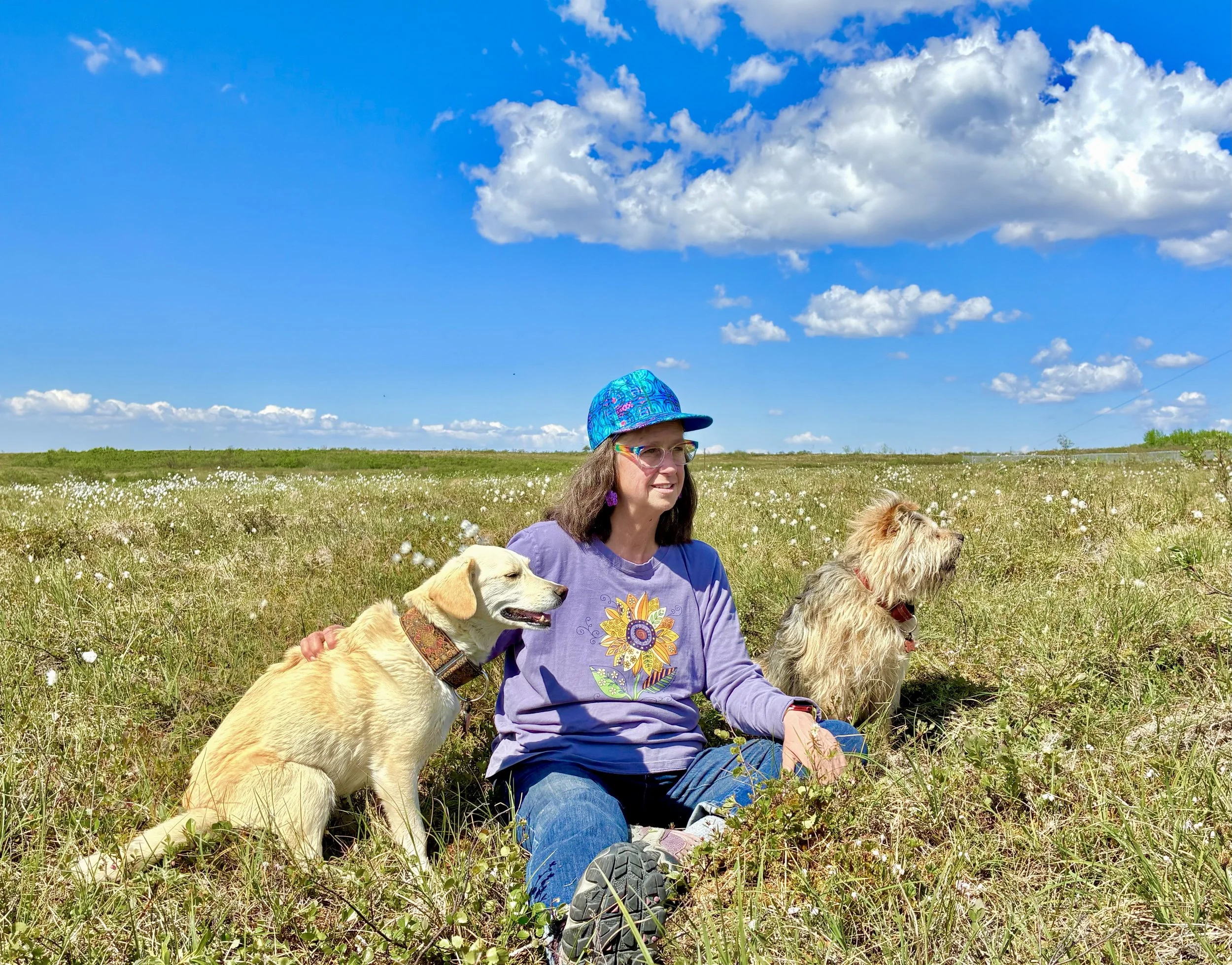
We are proud to spotlight the work and journey of Dr. Diane McEachern, a founding PC CARES collaborator, co-developer, and co-investigator. Dr. McEachern is faculty at the University of Alaska-Fairbanks Kuswokim Campus, where she leads the Rural Human Services program.
When Dr. Diane McEachern met Dr. Lisa Wexler through a chance connection at the University of Alaska-Fairbanks (UAF) fifteen years ago, Dr. Wexler had piloted a curriculum of 9 learning circles that incorporated about a dozen different bite-size pieces of research and a vision for suicide prevention that extended beyond traditional gatekeeper models. Dr. McEachern was inspired by Dr. Wexler’s commitment to, “translating research into down to earth ways of talking.” Both social workers with substantial experience working in – and with – remote Alaska Native communities, Dr. McEachern and Dr. Wexler’s partnership laid the groundwork for that initial list of twenty research insights to develop into the first ever PC CARES curriculum.
Currently, as Lead Faculty for the UAF Rural Human Services (RHS) program, Dr. McEachern helps “empower communities to work together based on research” with her students, who are all adult learners. Her students are trained as PC CARES facilitators to conduct community Learning Circles as part of their RHS practicum. The RHS program is a holistic educational environment grounded in an Indigenous pedagogy – incorporating Elders, talking circles, and storytelling to create a relationship-centered learning experience. By design, RHS and PC CARES share many parallels, allowing for rich synergy and collaboration between the two programs.
“What I hope to bring to PC CARES is that [PC CARES] is education that heals, learning with hope, and acting on knowledge.”
“In helping develop the [PC CARES] model over time, I wanted each learning circle [to] feel like a mini RHS class. PC CARES learning circles each start with a blessing from a local Elder, a brief participant check-in, and then it has bite-sized pieces of research that get shared. Most of the learning circle time is focused on participant learning, responses, and collaborating on actions. And that's how it is in the RHS program.. I try to provide knowledge and information for the class to engage together and talk through, often presenting back to the class…Basically, you're just translating it properly for the people who are participating,” shared Dr. McEachern. “RHS students come to the Kuskokwim Campus of UAF in Bethel for one week every /month for two academic years. This supports building a community of learners, time for students to settle in and increase confidence as a University student, and add what they learn to what they already know and practice as Indigenous people.”
Telling the story of the hunt
For Dr. McEachern, teaching within the RHS program has been about her learning as well. Her students have modeled an alternative framework of education grounded in never leaving anyone behind, collaborative learning, reciprocity, and healing akin to subsistence traditions.
“My students have taught me that education is so much more than what you might learn from a lecture or a book. It's how you interact with [knowledge], how you speak about it, how you share with other people,” said Dr. McEachern. “The Elders will often tell students that what they learn doesn't belong to them – that what they learn is not a possession, that it must be shared with everyone. I see RHS as another kind of subsistence activity. Just as hunters and berry-gatherers go out on the tundra, to gather food that they bring back to their community…so too are my students subsistence hunters. They gather knowledge, they make decisions about that knowledge, and they bring it back to their community. They tell the story of the hunt: what they learned, and how it might apply to their community. I encourage students that they will do the best in RHS if they are fully Yup’ik or Cup’ik and some students get tearful hearing that.”
RHS students are empowered to bridge the classroom and the community by “acting on knowledge.” As local PC CARES facilitators, they enact a powerful shift away from historically-rooted and present-day colonial practices of non-Native outsiders coming into Indigenous communities to extract, diagnose, and prescribe. Dr. McEachern has seen firsthand how PC CARES provides a structure for her students to grow into their community roles, develop their confidence, and even step into leadership.
“I remember one of my students saying one time that she was in a meeting with providers in Anchorage. They have a youth mental health treatment facility. There was a teenager from her village there, and they were doing case management. She was asking questions, and she was responding to suggested actions, and one of the [providers] actually said to her, ‘Where did you get your education? You are so deep in [the work]’. She was completing her last semester of RHS, and she was saying to me, ‘I could never be on a call like that before I was in this program, like I would never be representing my community on behalf of one of our people.’ And with PC CARES, and RHS students make similar comments about becoming facilitators on behalf of their communities,” shared Dr. McEachern.
A holistic interactive approach
Dr. McEachern recently made a trek down to the Lower 48 to help with the first ever Michigan Training of Facilitators. When she shared what she was doing in Michigan with her students, their excitement re-affirmed her commitment to PC CARES as the program continues to grow:
“PC CARES is an offering from Indigenous communities based in Alaska, because that's where it was grounded, and collaboratively developed.”
“Indigenous people in Alaska are offering PC CARES to other tribes or communities… Built into it is the assumption that participants know what to do. They decide the merits of the information, the community relevance, and the actions that could go along with the knowledge.”
When Dr. McEachern moved to Alaska almost thirty years ago, “People didn’t want to say the word ‘suicide’ and over time Elders let me and the students know if was time to talk about suicide prevention.” Now, PC CARES has broadened its impact to Michigan and Yakama Nation in Washington State, and is addressing new critical topics, including at-risk substance use.
“I’ve never really been part of designing something like this, and I can’t believe how blessed I am,” shared Dr. McEachern.
Want to learn more about RHS and PC CARES? Read our interview with RHS student PC CARES facilitator Elena John here.